Architecture
General diagram
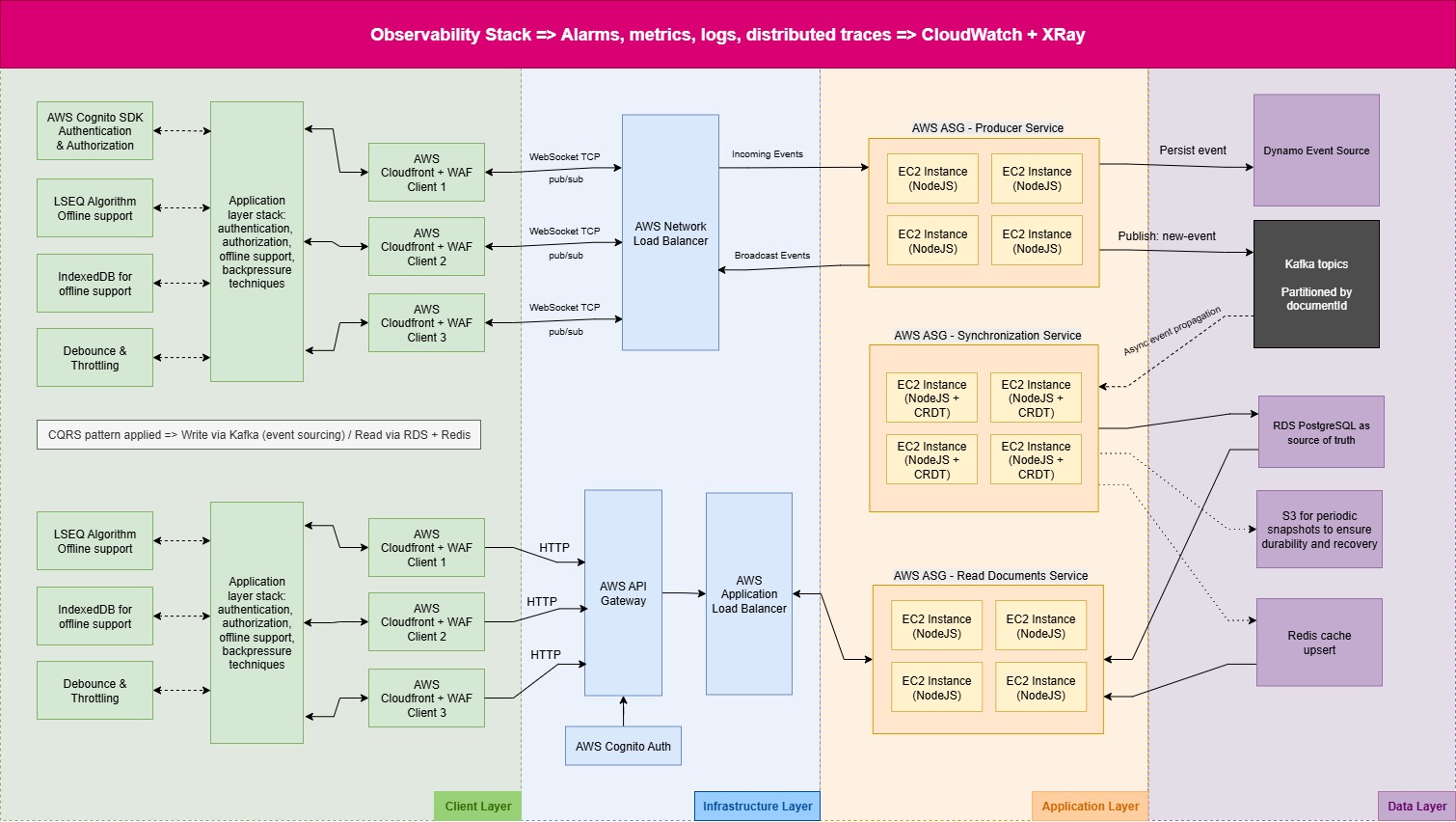
Real-time LSEQ Operation Flow with WebSocket, Kafka, and CRDT Sync
1. Client Operation Submission:
When a client generates a new LSEQ operation, it is sent via WebSocket.
2. Load Balancing & Scaling:
The operation passes through the AWS Network Load Balancer (NLB) and reaches an Auto Scaling Group (ASG) of EC2 instances that are subscribed to the WebSocket channel.
3. Broadcast to Other Clients:
The WebSocket channel propagates the operation to all other connected clients in real-time, ensuring immediate local updates.
4. Asynchronous Sync & Merge:
The operation is also published to a Kafka topic for downstream services responsible for CRDT-based conflict resolution and state merging.
5. Persistent Storage:
After merging, the final state is persisted in PostgreSQL, ensuring durable storage and eventual consistency across clients.
6. Key Benefits:
- Real-time collaboration with low latency.
- Offline operations can be queued locally and synchronized later.
- CRDT ensures conflict-free merging of concurrent edits.
Kafka decouples the real-time channel from persistence and background processing.
Sequence diagram - Publishing new event on WebSocket
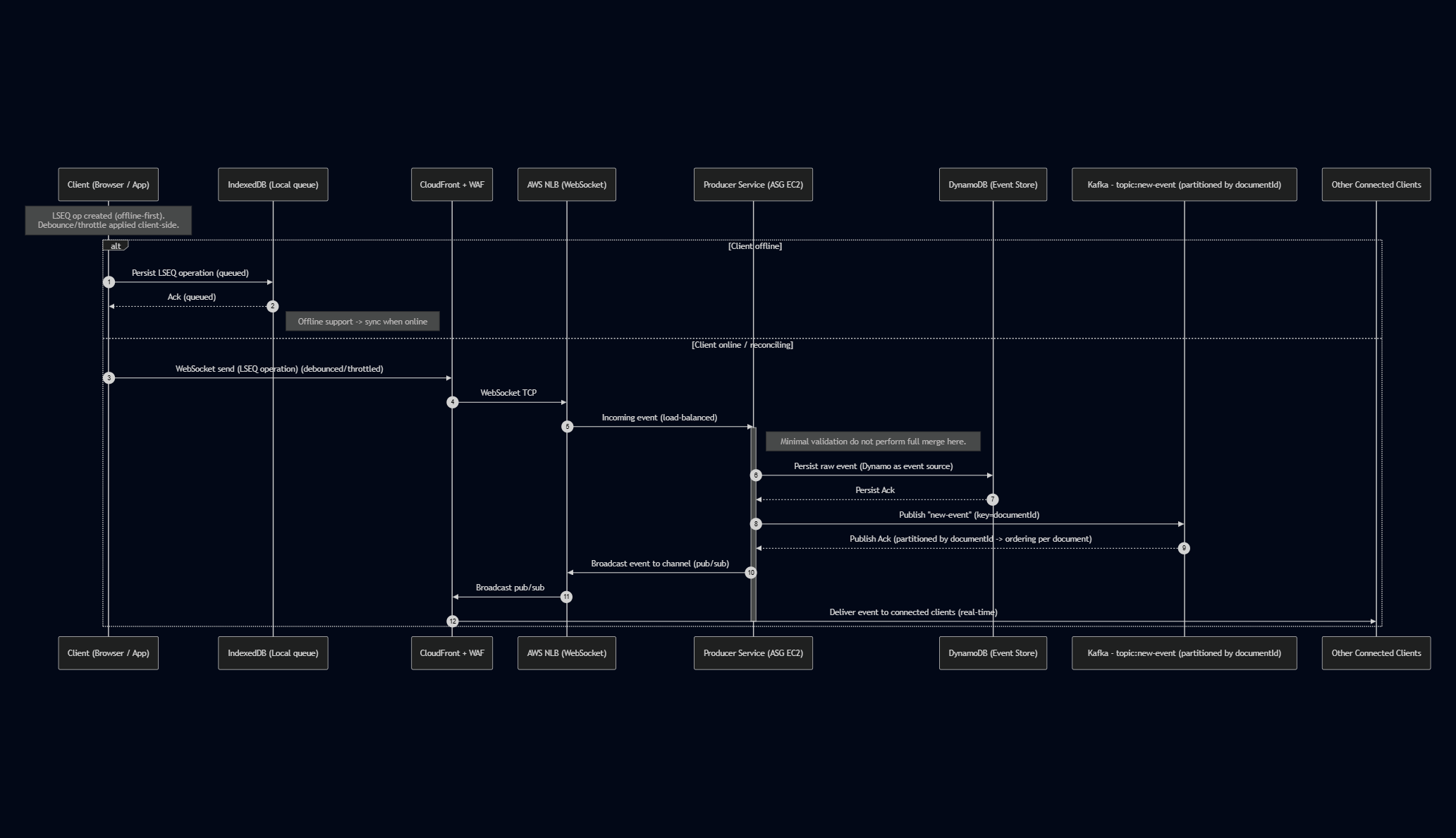
sequenceDiagram
    autonumber
    participant Client as Client (Browser / App)
    participant IndexedDB as IndexedDB (Local queue)
    participant CF as CloudFront + WAF
    participant NLB as AWS NLB (WebSocket)
    participant Producer as Producer Service (ASG EC2)
    participant Dynamo as DynamoDB (Event Store)
    participant Kafka as Kafka - topic:new-event (partitioned by documentId)
    participant OtherClients as Other Connected Clients

    Note over Client: LSEQ op created (offline-first).<br> Debounce/throttle applied client-side.
    alt Client offline
        Client->>IndexedDB: Persist LSEQ operation (queued)
        IndexedDB-->>Client: Ack (queued)
        Note right of IndexedDB: Offline support -> sync when online
    else Client online / reconciling
        Client->>CF: WebSocket send (LSEQ operation) (debounced/throttled)
        CF->>NLB: WebSocket TCP
        NLB->>Producer: Incoming event (load-balanced)
        activate Producer
        Note right of Producer: Minimal validation                                                        do not perform full merge here.
        Producer->>Dynamo: Persist raw event (Dynamo as event source)
        Dynamo-->>Producer: Persist Ack
        Producer->>Kafka: Publish "new-event" (key=documentId)
        Kafka-->>Producer: Publish Ack (partitioned by documentId -> ordering per document)
        Producer->>NLB: Broadcast event to channel (pub/sub)
        NLB->>CF: Broadcast pub/sub
        CF->>OtherClients: Deliver event to connected clients (real-time)
        deactivate Producer
    end
Sequence diagram - Synchronization service
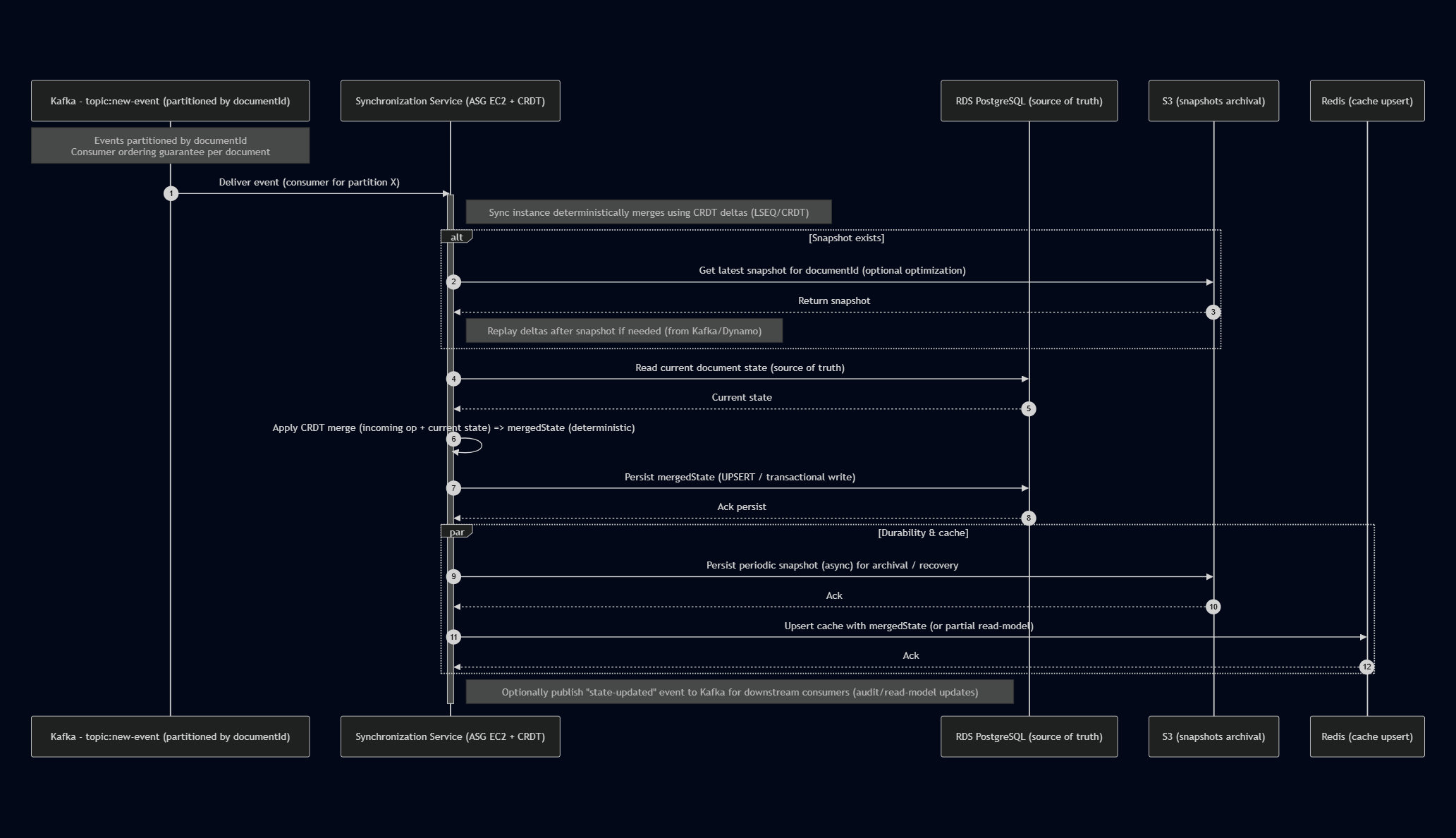
sequenceDiagram
    autonumber
    participant Kafka as Kafka - topic:new-event (partitioned by documentId)
    participant Sync as Synchronization Service (ASG EC2 + CRDT)
    participant RDS as RDS PostgreSQL (source of truth)
    participant S3 as S3 (snapshots archival)
    participant Redis as Redis (cache upsert)

    Note over Kafka: Events partitioned by documentId<br>Consumer ordering guarantee per document
    Kafka->>Sync: Deliver event (consumer for partition X)
    activate Sync
    Note right of Sync: Sync instance deterministically merges using CRDT deltas (LSEQ/CRDT)
    alt Snapshot exists
        Sync->>S3: Get latest snapshot for documentId (optional optimization)
        S3-->>Sync: Return snapshot
        Note right of Sync: Replay deltas after snapshot if needed (from Kafka/Dynamo)
    end
    Sync->>RDS: Read current document state (source of truth)
    RDS-->>Sync: Current state
    Sync->>Sync: Apply CRDT merge (incoming op + current state) => mergedState (deterministic)
    Sync->>RDS: Persist mergedState (UPSERT / transactional write)
    RDS-->>Sync: Ack persist
    par Durability & cache
        Sync->>S3: Persist periodic snapshot (async) for archival / recovery
        S3-->>Sync: Ack
        Sync->>Redis: Upsert cache with mergedState (or partial read-model)
        Redis-->>Sync: Ack
    end
    Note right of Sync: Optionally publish "state-updated" event to Kafka for downstream consumers (audit/read-model updates)
    deactivate Sync
Sequence diagram - Read documents service
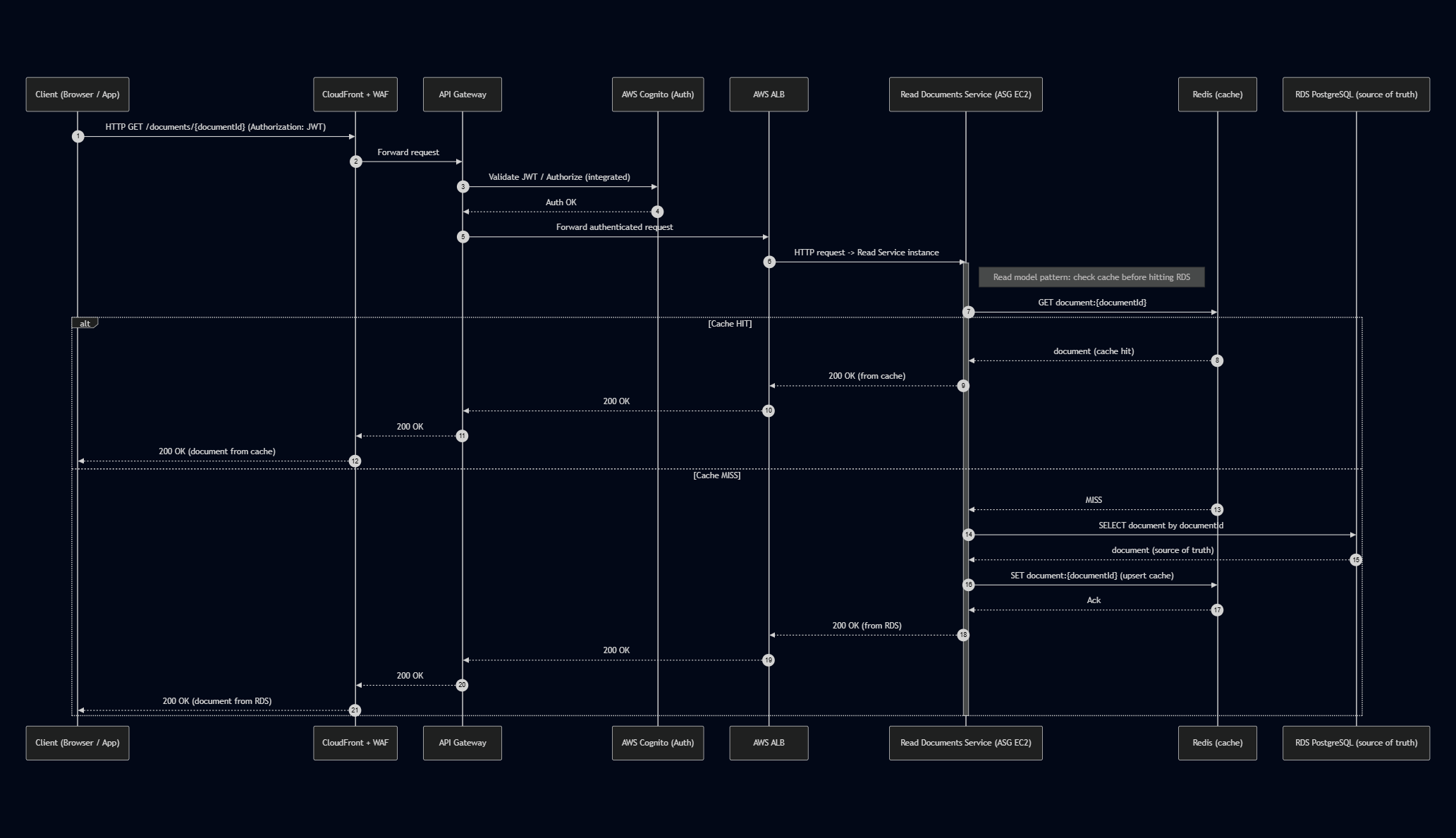
sequenceDiagram
    autonumber
    participant Client as Client (Browser / App)
    participant CF as CloudFront + WAF
    participant APIGW as API Gateway
    participant Cognito as AWS Cognito (Auth)
    participant ALB as AWS ALB
    participant ReadSvc as Read Documents Service (ASG EC2)
    participant Redis as Redis (cache)
    participant RDS as RDS PostgreSQL (source of truth)

    Client->>CF: HTTP GET /documents/{documentId} (Authorization: JWT)
    CF->>APIGW: Forward request
    APIGW->>Cognito: Validate JWT / Authorize (integrated)
    Cognito-->>APIGW: Auth OK
    APIGW->>ALB: Forward authenticated request
    ALB->>ReadSvc: HTTP request -> Read Service instance
    activate ReadSvc

    Note right of ReadSvc: Read model pattern: check cache before hitting RDS

    ReadSvc->>Redis: GET document:{documentId}
    alt Cache HIT
        Redis-->>ReadSvc: document (cache hit)
        ReadSvc-->>ALB: 200 OK (from cache)
        ALB-->>APIGW: 200 OK
        APIGW-->>CF: 200 OK
        CF-->>Client: 200 OK (document from cache)
    else Cache MISS
        Redis-->>ReadSvc: MISS
        ReadSvc->>RDS: SELECT document by documentId
        RDS-->>ReadSvc: document (source of truth)
        ReadSvc->>Redis: SET document:{documentId} (upsert cache)
        Redis-->>ReadSvc: Ack
        ReadSvc-->>ALB: 200 OK (from RDS)
        ALB-->>APIGW: 200 OK
        APIGW-->>CF: 200 OK
        CF-->>Client: 200 OK (document from RDS)
    end

    deactivate ReadSvc